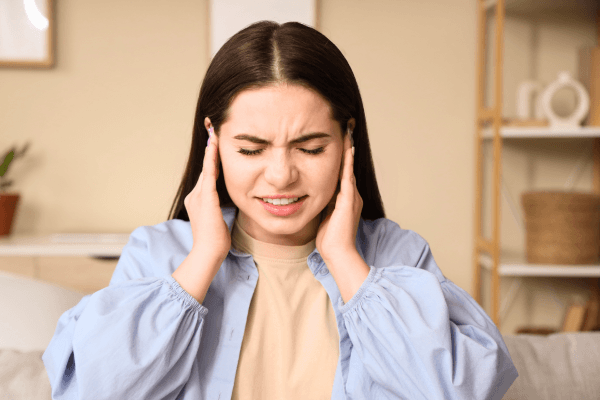
One of the most common and frustrating things we hear in clinic is this:
“The spinning has stopped, but I still don’t feel right.”
If you’ve been treated for benign paroxysmal positional vertigo (BPPV) and the intense vertigo has resolved, it can be deeply unsettling to still feel dizzy, off-balance or motion-sensitive. Many people worry that something has been missed, that the treatment didn’t work, or that this is now “just how things are.”
The reality is far more reassuring. Ongoing dizziness after BPPV is common, recognised, and explainable, and in most cases it responds very well to the right type of care.
What it actually means when BPPV is “gone”
BPPV is a mechanical problem of the inner ear. Tiny calcium carbonate crystals, called otoconia, become displaced from their usual position and enter one of the semicircular canals. When you move your head in certain ways, these particles shift and send false signals to the brain that you are spinning. That mismatch between what your inner ear is telling your brain and what your eyes and body are sensing is what causes the sudden, intense vertigo typical of BPPV.
Repositioning manoeuvres such as the Epley are designed to move those particles out of the canal so they stop triggering vertigo. When we say BPPV is “gone,” we are usually referring to the fact that positional testing no longer provokes spinning vertigo or the characteristic eye movements associated with it.
This is an important milestone in recovery — but it does not automatically mean the balance system has fully settled.
Why dizziness can linger after the spinning stops
Balance is not controlled by the inner ear alone. It relies on constant communication between the inner ears, the eyes, the muscles and joints of the body, and the brain itself. During an episode of BPPV, that system is thrown into chaos. The brain receives incorrect motion information, and in response it does what it does best — it adapts to keep you safe.
People often cope with vertigo by moving less, turning carefully, avoiding bending or rolling in bed, and relying heavily on vision to stay upright. These strategies are completely understandable. The problem is that the brain learns them very quickly.
When the crystals are repositioned and the vertigo stops, the brain does not always immediately trust that the danger has passed. Instead, the system can remain over-cautious. Movement may still feel threatening, balance may feel less automatic, and visually busy environments can become overwhelming. This mismatch — where the mechanical problem has been resolved but the nervous system has not yet recalibrated — is one of the main reasons people continue to feel dizzy after BPPV.
There is also growing evidence that the part of the inner ear the crystals came from, known as the otolith system, may remain irritated or under-functioning for a period of time. Even when the canal itself is clear, subtle changes in how the brain perceives head position and gravity can persist, contributing to ongoing unsteadiness or a sense of being “off.”
What residual dizziness feels like
Residual dizziness after BPPV is usually different from the vertigo that led you to seek help in the first place. Instead of short bursts of spinning, people often describe a constant or fluctuating sense of rocking, swaying or floating. Walking may feel less steady, especially in open spaces or when tired. Many people feel worse in supermarkets, shopping centres, crowds or when scrolling on screens.
These symptoms can be exhausting. Because they don’t look dramatic on testing, people are sometimes told everything is “normal,” which can feel invalidating and confusing. But residual dizziness is a recognised phenomenon in vestibular science, and it has a clear physiological basis.
The role of visual motion and the nervous system
After a vestibular event like BPPV, the balance system often becomes more visually dependent. Vision is an incredibly powerful stabiliser, but when the brain relies on it too heavily, visually complex environments can overload the system. This is why patterned floors, busy aisles, traffic and crowds can suddenly provoke dizziness even though you were fine with these things before.
At the same time, the nervous system may remain in a heightened state of alert. Vertigo is frightening, and the brain remembers that threat. Ongoing dizziness can be amplified by fatigue, stress and hypervigilance to bodily sensations. This doesn’t mean anxiety is the cause of your symptoms, but it can influence how strongly they are experienced and how long they linger.
For some people, particularly if symptoms persist for months, this pattern can overlap with a condition known as persistent postural-perceptual dizziness (PPPD). PPPD often develops after an initial vestibular event and is characterised by persistent dizziness that is worse when upright, moving or exposed to visually busy environments. Early, targeted management of residual dizziness can reduce the likelihood of symptoms becoming entrenched.
Why vestibular rehabilitation makes such a difference
Repositioning manoeuvres are essential for treating active BPPV, but they address only one piece of the puzzle. Vestibular rehabilitation focuses on helping the entire balance system recover and recalibrate after it has been disrupted.
Rehabilitation works by gently retraining the brain to tolerate movement again. Through carefully graded exposure to movements that have become uncomfortable — such as rolling, bending, turning or walking in busy environments — the nervous system learns that these actions are safe. Symptoms may be provoked briefly during this process, but with repetition they settle more quickly as the brain adapts.
Balance retraining is equally important. After a period of vertigo, many people lose confidence in their balance without realising it. Subtle changes in posture, stiffness or reliance on vision can persist. Targeted balance work helps restore automatic postural responses, improve sensory integration and rebuild trust in movement, particularly in situations like low light, uneven surfaces or multitasking.
For those who experience strong visual motion sensitivity, rehabilitation can also help the brain re-weight how it uses visual information. By gradually reintroducing visually complex environments in a controlled way, the system becomes less reactive and more resilient in real-world settings.
Education is a vital part of this process. Understanding why symptoms fluctuate, why fatigue and stress can amplify dizziness, and why avoidance can slow recovery often reduces fear and accelerates progress. When needed, strategies that calm the nervous system support this physical retraining and help the balance system settle more efficiently.
How long does recovery take?
Many people find that residual dizziness settles on its own within a few weeks. Others continue to feel off-balance or motion-sensitive for longer, particularly if symptoms were present for a long time before treatment or if movement avoidance has become ingrained.
Vestibular rehabilitation does not promise overnight results, but it often shortens recovery time, improves confidence and reduces the risk of dizziness becoming chronic. The earlier lingering symptoms are addressed, the easier it is to guide the system back to normal.
The takeaway
If your BPPV has been treated but you still feel dizzy, it does not mean the treatment failed or that nothing can be done. In most cases, it means your balance system needs time — and sometimes targeted support — to recalibrate after a significant disruption.
With the right assessment and a tailored rehabilitation approach, most people can move beyond residual dizziness and return to feeling steady, confident and in control of their movement again.
If the spinning has stopped but you still don’t feel like yourself, you’re not imagining it — and you don’t have to just wait it out!
Contact The Vertigo Co for a Vestibular Physiotherapy assessment to manage your residual symptoms today!